
Jackson Parish County Probate Records
Probate-type matters in Jackson Parish County are handled by the Civil Department and the District Court, not by a separate local probate court. The Jackson Parish Clerk Civil Department lists probate records as successions, interdictions, and emancipations. The same Civil Department receives, files, records, and processes civil claims, prepares the civil docket, and maintains court minutes.
That structure affects searches. A succession, interdiction, or emancipation may appear as a civil court matter rather than under a separate "probate court" label. Certified copies, docket minutes, and filing questions should be directed to the Clerk's Civil Department. For related real property transfers, a signed judgment or other document may also connect to the Recording Department.
Jackson Parish County probate records also sit within the Clerk's broader record-history limits. Court records date back to about 1880, but computerized court indexes begin in 1988. A recent succession may be easier to find through online civil inquiry than an older estate file, while an older probate record may need a staff-assisted search by name, year, or case reference.
The manifest image for this probate page comes from the official Civil Department page.
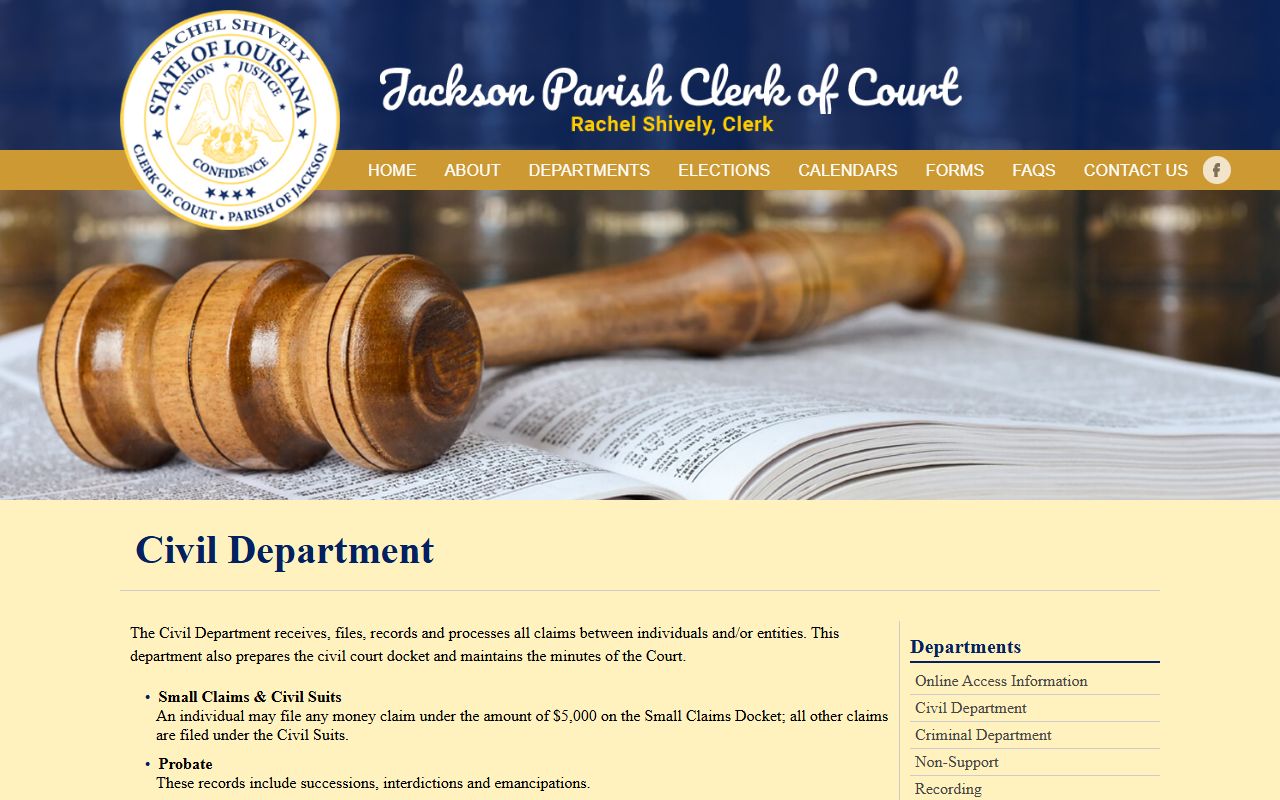
The Civil Department page is important because it confirms the local venue and the exact probate categories used by the Clerk.
Jackson Parish County Probate Terms
Louisiana probate language differs from some states. A person searching Jackson Parish County probate records should expect succession terms more often than a generic estate label. Interdiction and emancipation also appear in the local Civil Department list, so not every probate-related file is a will or estate transfer.
A succession is the local probate path most tied to a deceased person's property. Interdiction is different because it concerns an adult who cannot manage affairs and may require a curator or similar authority. Emancipation is different again because it affects a minor's legal capacity. Treating all three as "estate records" would blur the Clerk's actual categories, so searches should start with the specific case type when that is known.
- Testator
- A person who made a will.
- Executor
- A person named to carry out a will; Louisiana filings may also use succession representative terms.
- Intestate
- Dying without a valid will.
- Succession
- Louisiana court process for transferring a deceased person's property.
- Interdiction
- A proceeding to appoint someone to handle affairs for an adult who cannot manage them.
- Emancipation
- A proceeding that gives a minor certain adult legal capacities.
Search Jackson Parish County Probate Records
Start with the civil-record channel. ClerkConnect Jackson Parish Online Inquiry may include civil suits, but the research file could not confirm every internal search field without a JavaScript session or account. If ClerkConnect does not expose the succession or interdiction record, use the Clerk's counter, mail, phone, or email channel.
- Identify the record type: succession, interdiction, emancipation, or related civil filing.
- Search ClerkConnect under Jackson Parish civil suit access if the portal category is available.
- Use the decedent name, party name, case number, or approximate year if known.
- For older files, contact the Civil Department because court indexes are computerized from 1988 forward, while court records date back to about 1880.
- Request certified copies from the Clerk if the probate record must be used for banking, property, or another legal purpose.
Jackson Parish County Probate Search Fields
The available research supports a practical field inventory rather than a screenshot inventory. The table below follows the official probate channel and the limits noted during portal inspection.
Probate records can also be found through surrounding facts when the exact case number is not known. A succession search may start with a decedent name and approximate death or filing year. An interdiction search may use the respondent's name, while an emancipation search may require careful handling because minor information can be restricted. The Clerk's Civil Department is the fallback when those details are too thin for online inquiry.
| Field Label | Type | Required | Options / Format Notes |
|---|---|---|---|
| ClerkConnect Jackson Parish Inquiry | Online portal | Unspecified | Start with civil suits or probate-related civil search if available. |
| Decedent or party name | Text | Unspecified | Use name search where the portal permits; older records may need staff lookup. |
| Case number | Text | Unspecified | Best when known from notices, pleadings, or prior filings. |
| Date or year | Date/range | Optional | Helpful because computerized court indexes begin in 1988. |
| Copy or certification request | In person/mail | Not applicable | The Civil Department handles probate record copies. |
Jackson Parish County Probate Court Contact
The required probate contact is the Civil Department through the Jackson Parish Clerk of Court. The research does not identify a separate probate judge contact, probate division phone, or probate-only courthouse address. Use the Clerk contact information and ask for Civil Department probate assistance.
Staff assignments make that contact route more precise. Wendy Gaines is listed for Civil and Probate, protective orders, non-support, and passports. Dodie Ford is also listed for Civil, Probate, protective orders, and passports. Those assignments are useful for routing questions, but the public phone and mailing channel remain the Clerk's main office unless the Clerk provides a more specific instruction for a particular filing.
Jackson Parish Clerk of Court, Civil Department
Room 103, Courthouse Building
500 East Court Avenue
P.O. Box 730
Jonesboro, LA 71251
(318) 259-2424
clerk@jacksonparishclerk.org
Monday-Friday, 8:30 a.m.-4:30 p.m.
Jackson Parish County Probate Fees
Specific Jackson Parish County probate filing fee amounts were not located in the extracted HTML content. The Clerk's official forms page lists a court-cost fee sheet and advanced deposit requirements, so filing deposits should be confirmed from those Clerk PDFs or directly with the Civil Department before a pleading is filed.
| Item | Amount or rule |
|---|---|
| Probate filing deposit | Not stated in the extracted research; confirm with the Civil Department or official cost sheet. |
| Advanced deposit requirements | Listed on the Clerk forms page, but no extracted amount was available. |
| Plain copy | $1, from the Clerk fee table. |
| Certified copy | $10 plus copy fee, from the Clerk fee table. |
| Postage | Actual amount. |
Note: The copy fees are documented Clerk fees, but the research flags that civil/probate application should be confirmed before relying on them.
Jackson Parish County Succession Process
A probate filing moves through the civil court record system. The filing party first identifies the right matter type, then contacts the Civil Department for filing and cost requirements. The pleading is filed through the Clerk for the District Court, and the Civil Department prepares docket material and maintains minutes.
The documents in a Jackson Parish County probate record may include succession petitions, affidavits, inventories, judgments of possession, interdiction pleadings, curator or tutor appointments, notices, accountings, and orders. The exact contents depend on the case. A simple succession file may look different from an interdiction file with medical or capacity-related material, and some supporting documents may not be available to the general public.
Local probate flow: Identify matter › contact Civil Department › file District Court pleading › docket and minutes maintained › judge signs order or judgment › certified copies requested from the Clerk.
For successions involving real property, a judgment or conveyance-related document may also need recording after court action. That part of the process uses the Clerk's Recording Department, which is separate from the civil docket function but housed in the same unified Clerk office.
The local research did not locate a probate packet, attorney requirement rule, hearing schedule, or judge-specific probate contact on the official pages reviewed. For that reason, the process should be treated as an access map, not as legal filing instructions. The Civil Department is the source for current filing deposits, accepted pleadings, and whether a specific matter can be filed without counsel.
Restricted Probate Records
Most probate records are civil records, but access is not unlimited. Interdiction files may include medical or personal details. Emancipation records may involve minors. Adoption records are not public under the Civil Department's own statement, even though adoption appears near civil-family work rather than ordinary probate.
Public copies may also omit social security numbers, protected addresses, financial account numbers, minor information, or sealed attachments. A docket or judgment may be public while exhibits or supporting medical material are not. That distinction is important in interdiction and minor-related proceedings.
Public access also depends on whether the request is for inspection, a plain copy, or a certified copy. A plain copy may be enough for reference, while a certified copy may be needed to transfer property, satisfy a bank, or record a judgment-related document. The Clerk fee table gives copy and certification amounts, but probate filing deposits remain a documented research gap that should be confirmed before filing.
Louisiana law also affects access to probate procedure. The research points to Louisiana Legislature law search for statutes such as small succession procedure and public-record limits.
The state law search source is useful when a probate question turns on Louisiana succession procedure rather than a local Clerk access rule.