
Jackson Parish Criminal Records
A criminal court record is the case-level record kept by the court after prosecution begins. In Jackson Parish, the Clerk’s Criminal Department receives, files, and processes criminal suits filed by the District Attorney on behalf of the State of Louisiana. The official Clerk page says those suits involve people charged with breaking the law or indicted by a grand jury, and that criminal suits include felony and misdemeanor charges.
Jackson Parish is in the Second Judicial District Court, the general trial court for the parish. That court handles state criminal cases, while federal criminal matters are handled outside the parish through the U.S. District Court for the Western District of Louisiana and federal docket systems. The local case file is searched through Clerk channels. The jail roster is a custody and booking tool, and court charge records after arrest focus more closely on the charge allegations themselves.
The official Second Judicial District Attorney site is a key source for prosecution context because the DA is the office that files the state criminal suit after arrest, citation, indictment, or other charging decision.
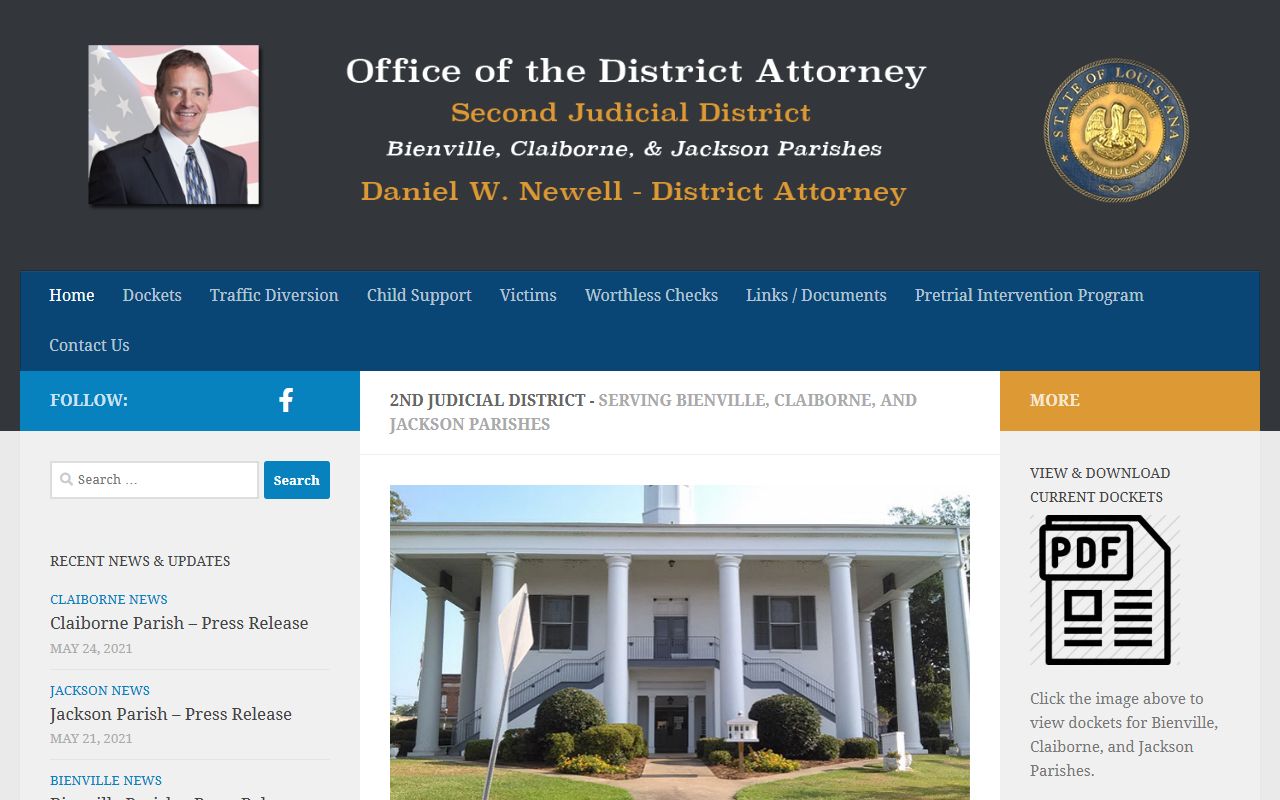
That DA role explains why a booking entry may not match the final charge list, plea, or sentence shown in the court record.
Search Jackson Parish Criminal Cases
The primary court-case search path is ClerkConnect Jackson Parish Online Inquiry, reached from the Clerk’s online access link. ClerkConnect states that criminal cases may be searchable depending on office features, and it also provides subscription and printing functions. If the portal does not show the case, contact the Clerk’s Criminal Department.
ClerkConnect should be treated as the first search channel, not the only criminal record channel. The research confirmed the public landing and Jackson Parish inquiry listing, but it did not capture a full criminal search screen or sample record without session access. Court records date back to about 1880, and computerized court indexes begin in 1988. A criminal case that is older, sealed in part, recently filed, or not exposed through the portal may require the Criminal Department by phone, mail, email, or counter service.
- Open ClerkConnect through the official Clerk online access route.
- Select Jackson Parish Clerk Online Inquiry and choose criminal case access if the portal offers a category choice.
- Search by defendant name, case number, filing year, or other known case details.
- Review the docket and minutes for arraignment, plea, motion, disposition, and sentence entries.
- Request a certified copy from the Clerk when the record must be used in court, licensing, or another formal setting.
For a broader court-record view, use Jackson Parish court records. For who is currently in custody, use the Sheriff inmate roster instead of the court case file. The Sheriff feed can show booking charges and bond lines, but it does not show the full criminal case disposition.
When requesting a certified criminal record, give the Clerk the defendant name, case number if known, approximate filing year, and the exact document needed. A docket printout, minute entry, bill of information, disposition, sentencing minute, and expungement order are not the same item. Ask the Clerk to confirm whether the record is public, redacted, sealed, or available only to a party or attorney before sending payment.
Criminal Case Stages
Criminal court records change over time. A case may begin with an arrest, citation, warrant, bill of information, or indictment, but the court file becomes most useful once the District Attorney files the criminal suit and the Clerk opens or maintains the case record. Each later event can add a docket entry, minute entry, order, plea form, or sentencing record.
Case flow: Charges Filed › Arraignment › Pretrial / Motions › Plea or Trial › Disposition › Sentencing
| Stage | What Happens |
|---|---|
| Charges filed | The DA files a criminal suit, bill of information, or other charging document with the court. |
| Arraignment | The defendant is advised of charges and enters a plea such as guilty or not guilty. |
| Pretrial / motions | Attorneys file requests, argue evidence issues, address discovery, or seek continuances. |
| Plea or trial | The case is resolved by plea, judge or jury trial, dismissal, or another court action. |
| Disposition | The record shows the outcome of each charge, not just the original accusation. |
| Sentencing | The court orders jail, prison, probation, fines, costs, restitution, or other conditions after conviction. |
What Criminal Records Show
A Jackson Parish criminal court record is strongest for case status and outcome. It can link a defendant to a filed charge, plea, motion history, disposition, and sentence. It may also show bond and cost entries, but bond and custody details can be more current in Sheriff jail records. If a person is trying to learn whether someone is still in jail, the court file is the wrong first source. If the question is what happened in the case, the Clerk record is the key source.
| Field | What It Shows |
|---|---|
| Case number | The court’s assigned criminal case identifier. |
| Defendant | The person charged in the criminal suit filed by the State of Louisiana. |
| Charges | The filed allegations, statute references, counts, and felony or misdemeanor classification where shown. |
| Arraignment | The plea entered after charges are read or acknowledged. |
| Motions and hearings | Requests, court settings, continuances, evidence issues, and related minutes. |
| Disposition | Whether a charge was dismissed, reduced, amended, pleaded, tried, or otherwise resolved. |
| Sentence | Custody, probation, fines, court costs, restitution, or other ordered terms. |
| Expungement entries | Filings or orders that may restrict public access under Louisiana expungement law. |
Charges vs Convictions
A charge is an accusation. A conviction is an outcome after a guilty plea, verdict, or other finding that establishes guilt. Jackson Parish criminal court records can contain charges that were amended, reduced, dismissed, or resolved differently than the jail booking entry first suggested. Read each count separately because one case can contain several charges with different outcomes.
| Charge | Conviction | |
|---|---|---|
| Meaning | An allegation filed by the prosecutor or grand jury. | A plea or finding that establishes guilt. |
| Timing | Appears early in the case record. | Appears after plea, trial, or final action. |
| Can change | May be amended, reduced, dropped, or dismissed. | May be appealed, set aside, expunged where eligible, or remain final. |
| Best source | Charging document and docket entries. | Disposition, minute entry, judgment, and sentence. |
Dispositions and Sentences
Disposition terms should be read with care. Dismissed means a charge or case was ended by the court or prosecutor. Nolle prosequi is a prosecutor’s decision not to pursue a charge. Guilty and not guilty refer to plea or verdict posture, while sentence entries show the punishment or conditions after conviction. A single record can show several charges, each with its own status and sentence result.
Sentences may include jail, prison, probation, fines, restitution, court costs, or other orders. Probation and parole terms are different. Probation is court-ordered supervision instead of, or after, custody. Parole is supervised release from prison before the full sentence has been served. If a record mentions a probation or parole warrant, custody information may also appear in the Sheriff inmate feed or warrant-related channels.
Sealed vs Expunged Records
Restricted criminal records require exact language. Louisiana’s expungement articles, Code of Criminal Procedure articles 971 through 995, govern the motion process, required forms, service, fees, and legal effect. The Clerk’s criminal page notes that former R.S. 44:9 expungement language was repealed by Act 145 and that required forms must be used. Juvenile Court is closed, and juvenile records are not public.
The local expungement workflow is also fee-specific. The Clerk research lists separate money orders rather than one combined payment: District Attorney, Sheriff, Bureau of Criminal Identification and Information, Clerk of Court, and Department of Public Safety and Corrections in DWI cases. The Clerk also warns that old forms may be rejected and fees will not be returned. That warning belongs in criminal court record searches because an expungement order can change public access to a previously visible charge or disposition.
| Sealed | Expunged | |
|---|---|---|
| Public visibility | Hidden from general public access by law or court order. | Public access is restricted under the expungement order and Louisiana law. |
| Record existence | The court may still keep the record under restricted access. | The record may still be available to authorized criminal-justice agencies or by court order. |
| Local process | Depends on the case type and court order. | Motion is filed with the Jackson Parish Clerk using required Louisiana forms. |
| Common limits | Juvenile, adoption, protected identifiers, and sealed filings. | Eligibility, fees, agency service, and DWI extra fee where applicable. |
Criminal Record Access Rules
La. R.S. 44:31 is the general Louisiana public-records access rule, and La. R.S. 44:32 governs custodian response duties. In practice, Jackson Parish criminal court records route to the Clerk when they are court case records, and to the Sheriff when they are booking, jail, law-enforcement, or public-records request materials held by the Sheriff’s Office.
Expungement fees are specific in the Clerk research: $50 money order to the 2nd Judicial District Attorney, $50 to Jackson Parish Sheriff, $250 to Bureau of Criminal Identification and Information, $200 to Jackson Parish Clerk of Court, and an additional $50 to Department of Public Safety and Corrections in DWI cases. The Clerk states that fees are nonrefundable and that staff cannot help complete expungement forms.
The District Attorney and public defender context also matters. The DA controls prosecution decisions, charge amendments, dismissals, pleas, diversion where available, and sentencing recommendations in state criminal cases. The research did not capture a specific Jackson Parish public defender office page with address and phone, so appointed-counsel questions should be raised at first appearance or through the court and Clerk channels for the current 2nd Judicial District public defender contact.
Note: Juvenile criminal matters are not public in Jackson Parish because the Clerk identifies Juvenile Court as closed court.
Federal Criminal Cases
Some arrests or investigations can lead to federal charges rather than a state case in the Second Judicial District Court. Federal cases are not filed with the Jackson Parish Clerk of Court. They are handled through the Western District of Louisiana, and docket access generally runs through PACER. Federal custody after sentencing is tracked through the Bureau of Prisons, not the parish court file.
The image below comes from the official U.S. Attorney’s Office for the Western District of Louisiana.
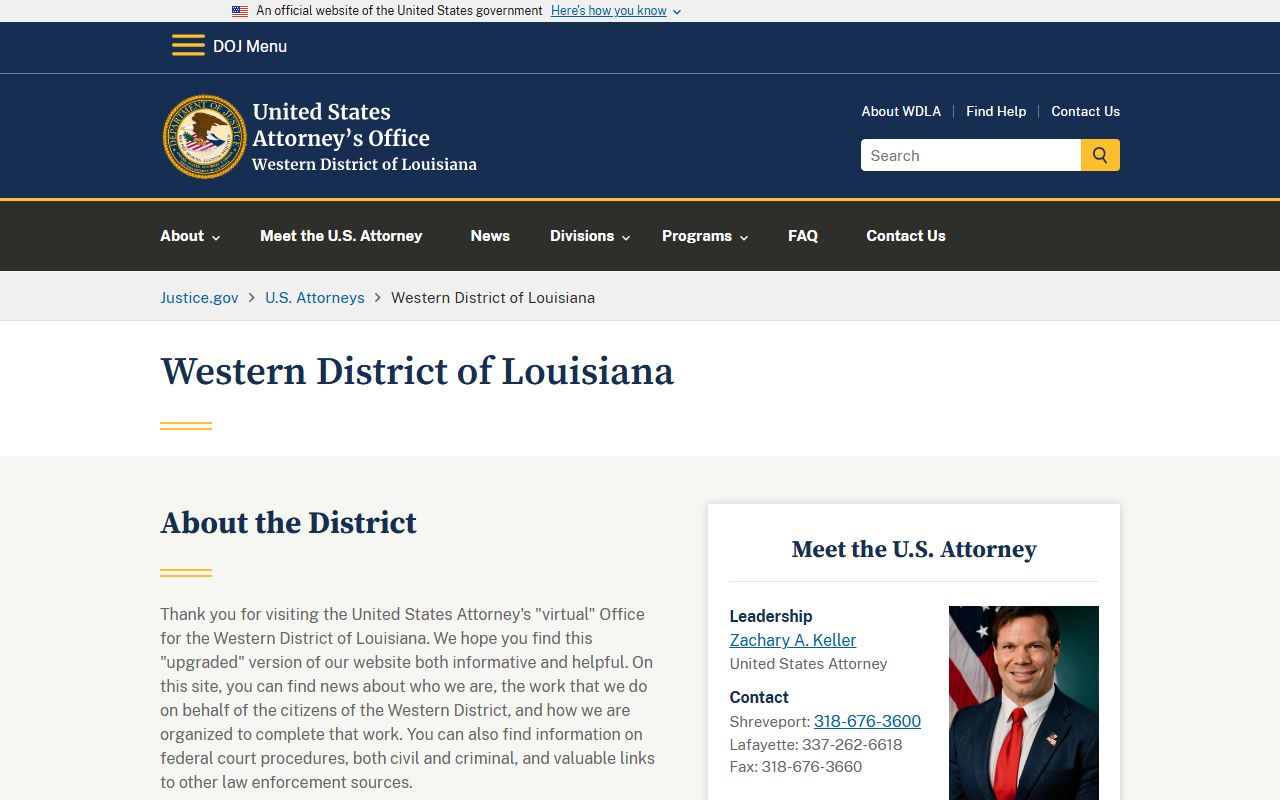
That federal source is separate from the local Clerk record, but it helps explain why some criminal matters do not appear in Jackson Parish state court channels.